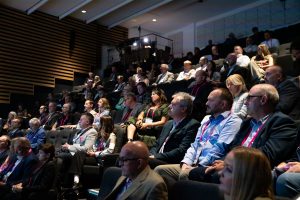
The auditorium was packed out for the speaker sessions
IR managing editor, Melanie Attlesey, attended the Independent Print Industries Association’s annual conference on Thursday, August 28, where the aim of the day was to provide PSPs with the knowledge required to chart new territory for growth and to think beyond the margin.
Do you ever feel like you are stuck in a rut? Doing the same things over and over again and not making any headway?
That’s the line of thinking the IPIA was trying to disrupt with its latest annual conference held at the Manufacturing Technology Centre in Coventry.
As an association the IPIA is committed to supporting its members and the UK print industry. Month in month out, it aims to help PSPs adapt to ever evolving market forces, enabling them to thrive.
The theme of this year’s conference was ‘Beyond the Margin’. More often than not, success in today’s print industry is measured by the margins. Speakers from across the print community took to
the conference stage to explore what happens when you look beyond the margin. Because according to the IPIA, real transformation happens when businesses look beyond these immediate pressures.
Print made this
Opening the conference was Brendan Perring, general manager of the IPIA, with an update on the association’s Print Made This campaign.
Launched at the 2024 annual conference, the campaign aims to transform any negative perceptions the end-user may have about print by showcasing the emotion and the feelings behind the print.
The IPIA has partnered with global insight agency Madano and various industry partners to analyse more than 12,000 online conversations to uncover how print is perceived across key buying markets.
Using this data, the IPIA, along with Carey Trevill from Mission Element, have approached influential voices from outside the sector – across fashion, photography, marketing and beyond – to build relationships and widen the conversation surrounding print.
“It’s about the effect print has with the end-user – the smile, the emotion. That’s the message we are trying to convey,” explained Brendan.
He was right. Print is so much more than a product.
Print is tangible and if the message is right, just think about the last time a sign or billboard made you smile.
This talk equipped attendees with the knowledge and the tools required to turn the IPIA’s insights into action and to strengthen the effect print can have on the end-user.
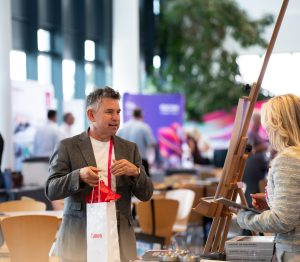
The IPIA Conference presented a fantastic networking opportunity for attendees
The power of being personal
Just before lunch, Gemma Mitchell, managing director of Paragon Dagenham, explored how physical marketing such as print offers a powerful antidote.
Her key objective was to get attendees to think about attention and how to keep the viewer engaged.
Although the talk mainly focused on direct mail, there were some points that Gemma raised which are transferrable to wide-format printers who produce physical print rather than digital.
For example, a piece of printed mail receives an average attention time of 108 seconds, compared to 1.3 seconds for a digital ad. The same piece of printed mail receives a 6x higher response rate
and 135% more engagement. Now imagine if the prints you produce are receiving the same level of attention and engagement over digital ads, you can begin to appreciate the effect you can have on the end-user.
And if you can somehow inject an element of personalisation into your final product, the level of engagement increases further. Because who doesn’t love to feel like they are one of a kind?
As Gemma said: “Cut through the noise – engage with purpose.”
Friend or foe?
Perhaps the most interesting element of the day came right at the end of the conference when four professionals from all corners of the print world engaged in a strategic conversation on the subject of AI and whether it should be considered a friend or foe in the workplace.
Arguments were put forward for and against the use of AI and some insightful points were raised.
The main takeaway point from the discussion was at this moment in time, most can agree that AI has replaced the more menial, admin tasks within a business, enabling those with certain skillsets
to focus on topline work. Essentially using AI as a business enhancement tool.

Rob Flannery of Nutshell Creative took part in the AI panel discussion
“AI provides the freedom to focus on creativity,” said Rob Flannery, sales and marketing manager at Nutshell Creative.
However, one downside to this use of AI is that it replaces the role of those starting out in the print industry – leaving no room for graduates or apprentices. This leaves businesses with a dilemma
– say no to AI and employ juniors at a cost to themselves or use AI and see the average age of the workforce increase.
Rob added: “AI is very much at a stage where it is picking up a lot of administrative work and a lot of tasks that you would typically expect to see on a job description of an entry-level role.
“People often enter the print industry with low responsibility. They do entry-level jobs so they can get exposed to other roles and responsibilities in the company and improve their skillset. With AI now picking up these tasks, where does that leave these job roles in the future? What opportunities are we giving young people of today? I don’t really have an answer.”
Like most tools used within a business, AI is only as good as the person using it. The person telling it what to do. It is critical to use the right large language model for the right application. For
example, you wouldn’t ask your lawyer to produce a great piece of artwork.
The panel suggested that when using AI, the human needs to take the lead. Any creative projects which use AI as an assistant should be overseen by a human to avoid a mundane level of creativity being produced.
Ultimately AI is here to stay and we will all find our own way of integrating it into our own businesses and utilising it to our advantage.
To conclude
Conferences like the one the IPIA organises on an annual basis are a great source of learning and networking for those in the wide-format print community. They equip attendees with vital information required to evolve and thrive in the current UK economy.
I would highly recommend attending a conference or event of a similar nature the next time the occasion presents itself. Who knows what you may learn.