
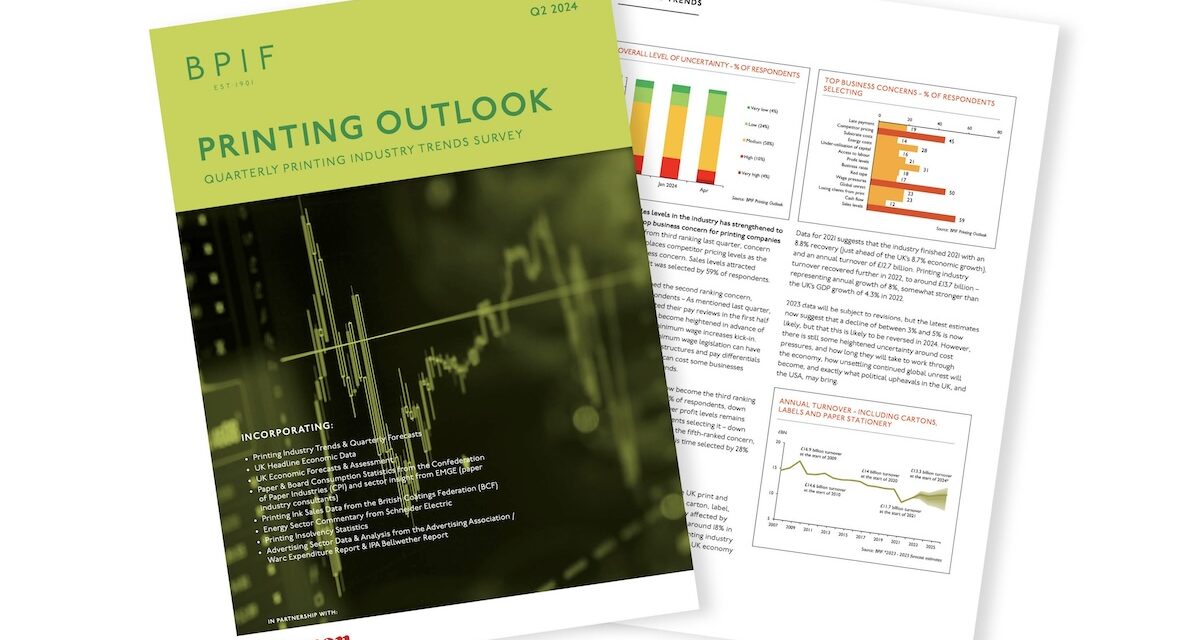
The BPIF’s Printing Outlook report for Q2 2024 shows that output and orders growth didn’t quite match the expectations for Q1, but that we have now had two consecutive quarters of growth, which is more than we have had since 2022.
The output balance of +5 was below the forecast of +8 for Q1. A balance of +25 is forecast for Q2.
The online trading trends survey was carried out during 2 April – 22 April 2024 and received responses from 111 companies employing 8,951 people with a combined turnover of £1.5bn.
The federation said that while the aggregated data has shown some stabilisation and improvement, much of that improvement is based on expectations for Q2. The Printing Outlook survey is still picking up mixed signals on the state of trade, and plenty of opinions on a number of issues companies are currently experiencing. On the general economy, and the environment companies are operating in – inflation is coming down, just not as quickly as might have been expected; interest rates are staying high, a costly annoyance to those repaying Government Covid loans; business rates are critically high for some companies; increasing administrative and compliance burdens on companies; but perhaps the most voiced annoyance was with the increase to the National Living Wage.
The new Q2 2024 Printing Outlook report contains an expanded section on sustainability, showing the growing importance of tackling sustainability issues, accountability, and enhancing sustainability credentials in the printing and printed packaging industry.
In April, 70% of respondents reported that they are measuring their carbon emissions (50% for more than 12 months, and a further 20% for less than 12 months), up from 56% in October, and 38% in April last year. That now leaves 29% not yet measuring their emissions, and a further 1% of respondents that weren’t sure if their company was measuring emissions or not.
The BPIF Printing Outlook Q2 2024 report features sections on industry turnover, business concerns, sustainability, costs, paper and board, pay reviews etc. Kyle Jardine, BPIF economist, said of the findings: “To elaborate on respondents’ comments related to the National Living Wage – companies do not wish to obstruct a fair wage being paid; in fact, many can benefit from having an open and transparent annual wage increase. However, the knock-on effect on maintaining wage differentials throughout the various skills employed can easily double budgeted pay rises. There can also be difficulties created in recruiting, and skill progression within companies, as a result of significant increases in minimum wages catching up with more skilled occupations.
“Despite these issues being raised, companies in the printing and printed packaging industry are working hard to maintain cashflow and profit levels. Controlling costs, productivity gains through capital investment, and diversification have all been key strategies companies are pursuing to ensure their survival.”
Charles Jarrold, BPIF Chief Executive, added: “Printing Outlook plays a crucial role in monitoring what is happening in our industry – we can more clearly see how the importance of sustainability is being accepted and acted upon. When we look at emissions measurement, it is promising to see that, in the last year, there has been a noticeable progression from companies starting measuring, through measuring just Scope 1 and 2, to incorporating Scope 3.
“Of course, measuring emissions is only a start, over four-fifths of respondents (82%) are working to reduce their carbon footprint. In the coming months we expect to see more companies setting emission reduction targets, and getting their targets validated by organisations like the Science Based Targets Initiative (SBTi).
“Finally, and as we eagerly approach Drupa, Printing Outlook suggests that the industry is generally more positive, which sets the scene for a really excellent expo for attendees and exhibitors, particularly as the new Q2 report shows that printing companies are interested in capital investment – especially if it can help boost productivity.”
A summary of the report’s key findings is as follows:
– Concern over sales levels in the industry has strengthened to make it the new top business concern for printing companies once more.
– Industry capacity utilisation remains concentrated in the 70-89% range in April, as it was in January.
– More companies increased, than decreased, employment levels in Q1. However, recruitment success has often struggled to hit the expectations for securing new employees. Despite this, recruitment expectations remain positive for Q2.
– Average price levels continued to decrease, on balance, in Q1, although a slender majority did manage to hold their prices steady.
– Labour costs remain the most prominent costs concern for companies, but there are signs that pressure is building for other cost increases. More companies are now starting to see a return of paper price increases.
– A majority of printing companies were able to hold margins steady in Q1, but margins remain under increased pressure, on balance, as the cost increase and price reduction squeeze is maintained.
– When it comes to company plans to increase profitability in the next 12 months, cost control remains the primary area of focus, as it has since July 2023.
– Just over half (52%) of respondents reported that they had conducted a pay review in Q1, the resulting average (mean) change in basic pay was 5.1%.
– Export orders exceeded 5% of turnover for 18% of respondents in April, up from 12% in January. For these companies export orders continued to perform poorly in Q1.
– The importance of tackling sustainability issues, accountability and enhancing sustainability credentials continues to grow in in the printing and printed packaging industry.
– In April, 70% of respondents reported that they were measuring their carbon emissions.
– UK consumption of printing papers and boards in Q4 recovered slightly from the record low recorded in Q3. Early data for 2024 is looking considerably stronger in comparison to 2023.
– The last three months has seen a moderate quarter-on-quarter rebound in natural gas and electricity wholesale prices, after an initial dip in February to levels last witnessed nearly three years ago.