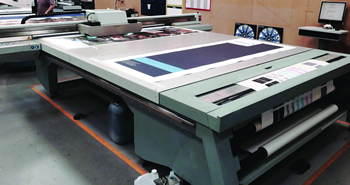
Pantone graphics colour bridge
Each year Pantone releases its Color of the Year to create a conversation around colour, and highlight the relationship between colour and culture. But what is a Pantone reference and just how relevant to the wide-format print market are they?
Described as a warming, brown hue imbued with richness, Mocha Mousse Pantone 17-1230 TCX is this year’s winner.
The Pantone colour-matching system was invented in the early 1960s to provide designers with a way to compare specific shades, regardless of the process used to produce them. Many companies and brands use a specific reference to ensure an exact match every time. Even the little yellow Minions from the film franchise ‘Despicable Me’ have their own reference called Minion Yellow Pantone 13-0851 TPG.
CMYK printing
According to Pantone, CMYK printing is based on the clever use of red, green, and blue filters (in the form of cyan, magenta, and yellow ink) to subtract, or filter, different wavelengths from the white light reflected by the substrate.
The amount of light filtered by each ink can be varied by allowing some of the background (substrate) to show through unfiltered. This is called ‘screening’. A screened area with a uniform percentage of ink (for example a patch screened so that it is 70% cyan ink and 30% paper) is called a tint. Theoretically, when equal tints of cyan, magenta, and yellow are combined this should result in a neutral shade of grey, and when all are at 100% ink and 0% paper, this should appear as black.

Limited Edition Pantone FHI Color Guide 1
When it comes to printing Pantone colours using a CMYK process, achieving an exact colour match can be a challenge. The main difference you will find between Pantone and CMYK printing is the level of accuracy when it comes to the final colours. This is mainly because of the limited range of shades CMYK can produce using a four-colour process. To complicate matters further, some printers now offer a fifth, sixth or seventh colour to expand the gamut in different directions. There is even the Roland DG TrueVis XP-640 which now offers red as an eighth colour.
One other challenge you may encounter is the variation in colour output between different printers and printing processes. The same CMYK values can produce different results depending on the quality of the printer, the type of media used, and the printing method employed. Whereas, the Pantone system will deliver an exact colour match, each and every time.
Conversion possibilities
If your customer approaches you with an exact Pantone reference they would like to use, it is entirely possible to convert from one colour space to another. There are plenty of online tools available which will convert Pantone shades to CMYK codes and vice versa. Alternatively, switching your file’s colour mode in Adobe Illustrator or Photoshop will also convert the colour values for you. Pantone has helpfully even created its own Color Bridge Guide Set, which provides a side-by-side comparison of all 2,539 Pantone references, with their closest industry-standard CMYK colour matches.
Ultimately, with Pantones being solid colours they are a valuable reference guide, but not a recipe.
And for those who are curious and would like the CMYK code for Mocha Mousse, it’s C: 0%, M: 27%, Y: 39%, K: 36%.