Wherever there is printing, there is ink; and wherever there is ink you have cartridges. As necessary a component it is, they leave much to be desired in the way of sustainability. Yet there are those looking to change that with Mimaki and Epson both looking at ways to do away with the old style. Assistant editor Benjamin Austin reports:
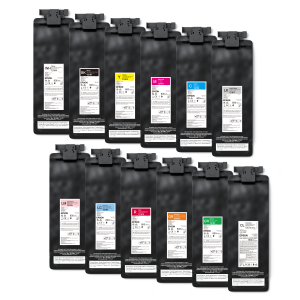
Epson’s ink foil bags
‘Hitchhikers Guide to the Galaxy’ author, Douglas Adams, once claimed ‘books are like sharks.’
It was a comical comparison in which he highlights that despite multiple attempts to improve their designs, neither sharks nor books have been bested in either style or function.
Now the same can’t be said for the majority of the wide-format print industry with companies constantly striving to improve for their customers; with a current emphasis on sustainability.
Some machines work with faster speeds to reduce runtime and thus save on energy costs while developments in inks have brought customers eco-solvent or water-based latex products which offer greater environmental benefits without performance drawbacks.
Yet one feature of printers that has seemingly stayed consistent throughout the technology’s lifespan is that of the cartridge.
But recently the trusty ink vessel has been going under a renaissance with companies like Mimaki and Epson both looking to improve upon its design for the sake of sustainability.
Improving perfection
A typical ink cartridge is made primarily of a plastic case holding an ink pouch inside. Nowadays there are multiple routes you can take to dispose of them; through company initiatives or local authorities but it proves a time-consuming task and is often easier to dispose of by sending them to a landfill.

Mimaki’s cardboard ink cartridges
But, since 2023 Mimaki has been producing a cardboard version in hopes of revolutionising the way companies dispose of their empty cartridges.
These new products work in the same way as a conventional cartridge but the outer casing is instead made of cardboard.
They were initially introduced to the Japanese markets before Mimaki started distributing them to other parts of the world last summer.
Hybrid Services, which is the official distributor of Mimaki printers for the UK and Irish markets, has been enthusiastic about the change.
Sales director, Andy Gregory, said: “It’s great that globally, Mimaki has addressed the environmental impact of plastic use in ink cartridges.
“Moving to a cardboard solution reduces plastic use by 68% which Mimaki estimates will annually eliminate 44 tonnes of plastic which equates to 65 tonnes of CO2 emissions.
“And the fact the cartridges are made of cardboard means they’re lighter, so from a shipping perspective there is an impact in CO2 emissions in transporting them so it’s one of those things that has lots of knock-on effects.”
The concept, though in its infancy, has already picked up a lot of traction as Mimaki has received awards for its efforts with cardboard cartridges.
In 2023, the company won the Industrial Packaging Category Award at the Japan Packaging Contest and in February this year it also took home the Sustainable Product of the Year at the Sign Industry Awards which was presented to Hybrid on its behalf.
Andy said: “Mimaki continually reviews and improves its product range and this development has been born out of their focus on implementing positive changes.”
Currently, the cardboard packaging is available with the company’s best-selling SS21 and SS22 solvent inks.
In addition to Mimaki’s packaging developments, Hybrid has, since 2008, operated a recycling scheme for its solvent ink cartridges. Its ‘Let’s Do More’ programme is free to use, and rewards sign makers with a valuable ink rebate, whilst helping them responsibly manage their print waste.
Alongside its cardboard cartridges, Mimaki has evolved the packaging for its wide range of inks to include larger formats such as bottles and pouches, the latter of which are shipped in cardboard boxes and fit into reusable “eco cases” that remain on the printer.
Like the cardboard cartridges, these reduce single-use plastic consumption as well as the shipped weight of the product.
Outside the box
As much as it is revolutionary to redesign the cartridge it is even more revolutionary to do away with it altogether, yet this is the direction Epson has decided to take.
It has been a concept the company has been using with its textile machines for around eight years and has been trialling in its sign and graphics hardware for three.
But it has officially brought cartridge-less printing as standard to its portfolio of signage printers with the release of its SureColor SC-S9100 launched at this year’s Sign and Digital UK.

Sales director Epson UK, Phil McMullin
Phil McMullin, head of sales commercial & industrial at Epson UK, said: “The best thing for us as an industry but also globally is to just use less.
“That can be quite difficult as all businesses are looking for growth and by definition, if you’re looking for growth, odds are you’re using more stuff so it can be counterproductive.
“The best way to minimise everyone’s carbon footprint is to do away with plastic cartridges altogether.”
Instead of buying a standard cartridge, customers can now buy a larger 800ml or 1.5l ink pouch which is then placed unopened directly into the ink tower. This not only keeps waste materials minimal but also reduces the risk of spillage when inserting the ink into the machine. The pouch is also delivered in a cardboard box.
Phil continued: “What you’re left with is a very small amount of product that can be recycled which is the empty foil bag instead of massive plastic cartridge that needs to be moved around.
“One of the challenges of reusing empty ink cartridges is you have to get them from the customer back to the manufacturing plant.
“That in itself has a carbon footprint as that has to be put on a truck or a van and you have to physically move it and quite often, because of the economy of scale, the production plants aren’t near where the customer is.”
The company has continued the transition to ink pouches further with the release of its SureColor S7100 in March.
With the packs as standard, the printer manufacturer hopes to lower the frequency of ink replacements, while being 84% lighter and generating 91% less waste per pouch.
The same battle
Both companies have brought forward two different solutions to the same problem with both hoping to achieve a similar result; making print more sustainable.

Sales director Hybrid, Andy Gregory
As much as every business wants to go green it sometimes isn’t viable to do so on their own so it is vital big manufacturers like Mimaki and Epson are helping pave the road to greener work practices.
Phil said: “In my view what’s important is for the smaller businesses and even the medium to the larger size businesses, they can’t or can’t afford to be environmentally friendly but they expect companies like Epson to lead the way and provide that tech at an affordable price and no price premium.
“If we make it available, they will adopt it when the time is right so I see that as our mission.
“All of this is baby steps to the end goal of our industry becoming cleaner. We all have a long way to go and Epson will be the first to say that we’re just on a journey.”
Andy concluded: “All of these things are part of Mimaki’s DNA. Their goal is to deliver the best and most effective print technologies across the many sectors they operate in, and incorporating a strong commitment to sustainability forms an important part of this.”
It’s not so much a reinventing of the cartridge but more of a redesign for the new sustainability-focused environment in which wide-format printing now sits.
Similar to the hammerhead shark, it hasn’t done away with any of its ancestors but instead improved upon the design to fit the world in which it thrives better than its counterparts.
Necessity is the key to the invention and as environmental factors need more attention; companies will look at inventive ways to help meet it.