
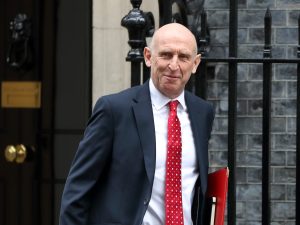
John Healey, Chancellor of the Exchequer
The Autumn Budget is one of the most anticipated political statements each year, with households and businesses alike affected by the Chancellor of the Exchequer’s dictations and decisions proposed for the next financial year.
Yesterday, John Healey recognised early on that all eyes would be on him as he delivered his one-hour-long speech to the House of Commons, saying he was “expecting to be the most viewed politician of the week if it wasn’t for the Prime Minister’s appearance on Gogglebox”.
Like the show, MPs in attendance were continuously commenting as the show unfolded. But as Mr Healey worked through the policies, the ambient noise in the room gradually quietened as his points met very little ridicule, instead leaving those of the opposition to jeer at linguistic errors.
The main one was when discussing the Jackdaw gas field, Mr Healey accidentally said the energy secretary, Miatta Fahnbulleh, ‘opposed’ the action, meaning to say the opposite. It led to an eruption of jeers, only for Deputy Speaker, MP Nusrat Ghani, to calm down proceedings, even going so far as to single out Dr Luke Evans, suggesting he’d ‘need to write a prescription to calm down’.
It did eventually settle down to allow everyone to breathe, which was ironically the message from the Chancellor, having used the phrase ‘breathing space’ nine times as he recited his party’s policies.
The point being he wished to provide just that to households and businesses, making short-term promises as they prepare for long-term adaptations.
External factors
To start, Mr Healey recognised the impact of external factors, saying “worldwide pressures are hitting the wallets at home.”
With the war in the Middle East continuing without any solid resolution, it pushed oil prices to more than $100 a barrel, up from $70 before it broke out.
This has meant higher prices at the pump, increased energy bills and a raise in mortgages. It has impacted business too, as it has led to higher running costs and higher business loans.
It is an impact that is already having an effect on companies, as a recent survey from Enginuity found that almost 3/4 of those asked said they are willing to pass the buck to their customers.
Reacting to the budget, Ann Watson MBE, CEO of Enginuity Group, said: “The Chancellor was correct to recognise the significant pressures facing businesses.
“The number of SMEs in the sector under pressure to raise prices due to energy costs had also more than doubled since the previous survey.”
Bearing the brunt
In his speech, Mr Healey laid out measures to help bear the brunt of the rising running costs.
He said: “In the first week of our new Government we took VAT off electricity. Today I am extending that cut to July taking off £50 to the price cap.
“I know with the conflict in the Middle East rising energy bills are a real worry and people look to the government at time like this not to solve their problems but to give the breathing space.”
Whether you believe it solves the issue or simply kicks it down the road, it will be a welcome extension to those fearing energy spikes.
Ms Watson added: “The Chancellor’s actions to reduce energy costs facing employers are therefore certainly a welcome step. However, greater emphasis must now be placed on reducing the wider costs SMEs face, so they are able to create more jobs and invest increasing amounts in training the next generation.”
The Chancellor has laid out foundations for further investment into small businesses, hoping to help young entrepreneurs grow their businesses and to keep these enterprises within the UK to help strengthen the country’s economy.
He said: “The biggest barrier to fast growth firms in Britain is investment in Britain. In today’s budget, I’m boosting investment through our public financial institutions.
“A further £20.4 billion for the national wealth fund and British Business Bank over the coming years, supporting 140,000 jobs.”
“Britain doesn’t lack great entrepreneurs. High growth firms make up less than 1% of small and medium-sized businesses, yet they generate more than 1/2 the output.
From the startups of today to the scale-ups of tomorrow to the billion-pound companies of the 2030s, I want to see them stay and succeed in Britain.
“For those just starting, I’m tripling the trading allowance, meaning what you can earn from a new venture tax-free goes from £1,000 to £3,000.”
Mr Healey also laid the groundwork for younger minds to get into business. He said: “I’m launching a young entrepreneur’s allowance which will cover living costs for young founders while they turn their ideas into businesses.
“And, as recommended by the Women in Tech Task Force, I’m announcing a new scale-up programme to support female founders, and the British Business Bank will double its commitments to women-led businesses and funds to £200 million.
“We need to get the best talent into the fast-growth firms, so I’m reforming skilled worker visas and non-compete clauses in worker contracts so the people who helped build one successful company can easily move onto the next one.
“I know starting a company means taking a risk. Often it means leaving a secure job and building something that has no guarantee will work.
“I know business founders take that risk, build an exceptional company, create wealth for Britain. We should recognise that success and keep those people here to invest again.”
The printing sector
This was a notion welcomed by many in the printing sector, one namely Phil McMullin, head of sales, commercial and industrial printing and business systems, Epson UK.
He said: “Backing British businesses to grow starts with helping more people take the first step into business. That includes the designer launching an online shop, the maker creating personalised gifts and the sole trader building a customer base from home.
“Today’s Budget placed a welcome emphasis on supporting small businesses, including additional backing for the British Business Bank. The priority now is ensuring that support reaches these entrepreneurs at the earliest stages, alongside more established firms looking to expand.
“The success of today’s measures should be judged by how straightforward they are for a first-time business owner to access and use. People starting from home or alongside another job need a clear route to support and the confidence to invest and plan. Helping them turn their first orders into a dependable income deserves a place in the UK’s growth ambitions.”
It therefore does seem Mr Healey and the Labour Party are willing to breathe a fresh perspective into the matter, and calm the waters – at least for now – by creating a budget that is ‘for the working people of Britain and for British businesses, big and small’.
There will be opposition to the claims made, and as with all the best-laid plans, they don’t always come to fruition, but for now we can all take a deep breath knowing what the immediate future should hold.