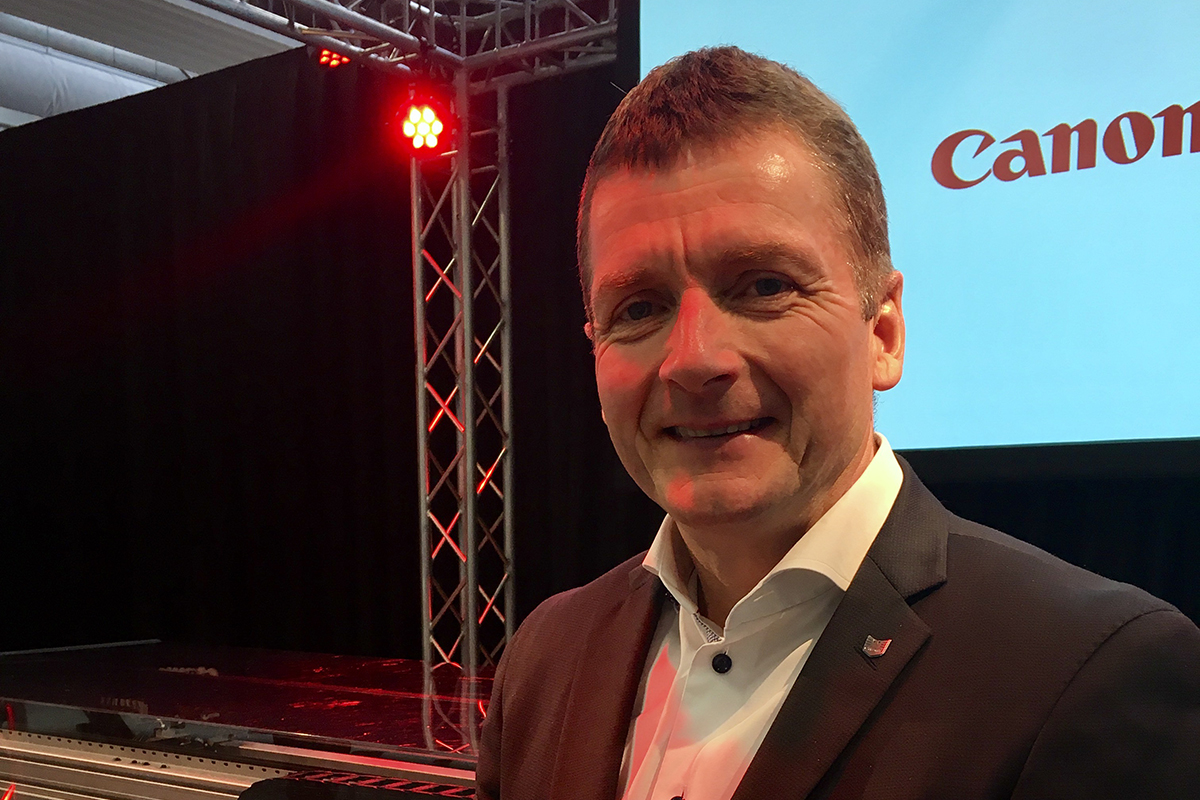
Gilad Tzori, COO of frontline.io
Gilad Tzori, COO of frontline.io, outlines how and why the wide-format print sector is being transformed through the utilisation of digital twin technology.
The high-volume commercial printing industry is pressured to modernise in an increasingly digital world where margins are tightening, environmental regulations are ever-evolving, and customers expect quick turnarounds with higher quality output. As a result, many print service providers are exploring new technologies that can help ensure operations are error-proof and ready to meet future demands.
Digital twin technology, when integrated with artificial intelligence (AI), emerges as a key strategy for overcoming operational challenges. This innovation gives businesses control over complex printing systems through real-time monitoring, remote maintenance, predictive insights and immersive remote training. Used widely in sectors like aerospace, manufacturing and logistics, digital twin technologies paired with AI offer tangible benefits to the printing sector. This is particularly true for wide-format operations, where machine uptime and job quality are critical to operational success.
What is a digital twin?
A digital twin is a replica of a physical asset, such as a printing machine, print engine or even an entire print line, represented in a virtual environment in augmented reality (AR) or virtual reality (VR) modes. The virtual model mirrors the real system’s behaviour, performance and operating conditions. It uses a complete parts catalogue to learn the machine and continuously updates based on incoming data, allowing users to simulate and analyse equipment remotely. In the high-volume printing industry, where machinery can be highly complex and specialised, digital twins are uniquely equipped to handle these intricate systems.
Using digital twin technology accessible across extended reality (XR) platforms, manufacturers can rapidly convert existing CAD files into interactive 3D simulations across AR, VR, desktop, tablet and mobile devices. This process is generally complex and tedious, often taking days to weeks or even longer for highly intricate designs. Through a specialised XR training and remote support platform, like frontline.io, HP creates and deploys content across global teams five times faster than traditional content creation methods. This cross-device compatibility and quick conversion make it easier for print companies to provide accelerated, scalable training and support solutions for their teams.
Industry challenges that demand change
Operational challenges affect printing businesses from top to bottom, impacting everything from efficiency and profitability to workforce competency and market competitiveness. Downtime is expensive, misprints can lead to customer dissatisfaction and unscheduled service visits are disruptive. Preventative maintenance routines often rely on manual checks, consuming technician hours and leading to inconsistent results that may require further inspections. Furthermore, traditional materials, such as PDFs become outdated and lack the interactivity needed to engage today’s workforce. Digital twin technology can allow printing companies to quickly create, update and deploy interactive content, ensuring that reference material is always current and relevant.
The search for skilled recruits can also greatly impact a business’s operational efficiency. As experienced technicians retire or move into other roles, onboarding new hires quickly and safely can be challenging. Traditional training methods require physical machines and time-consuming shadowing, which can delay productivity and widen the knowledge gap. By enabling new hires to pause, repeat and explore procedures at their own pace, these virtual simulations provide access to crucial hands-on experience, ensuring the workforce is adequately prepared.
Beyond operational efficiency, sustainability represents a critical priority that demands immediate attention. Waste reduction and carbon-friendly practices are increasingly important to customers and regulators alike. Companies are increasingly becoming corporate citizens, and the need to overhaul wasteful operations is paramount. Remote training and support powered by digital twin technology are crucial in achieving this sustainability goal. Operational support becomes readily available regardless of location, thus eliminating any distance-related hurdles or inaccessibilities. Additionally, by effectively addressing quality inconsistencies, misprints and repeated calibration runs, companies can decrease material waste and energy consumption, improving their environmental impact.
 Remote training and support with extended reality
Using XR tools, such as augmented reality (AR) or virtual reality (VR), with software that performs digital twins, allows new staff to train on complex print equipment in a safe and fully simulated environment. This approach eliminates expensive, dedicated training machines, reduces travel costs to distant training sites and avoids the need for onsite trainers. Printing providers can choose XR training platforms that function seamlessly on headsets, tablets, PCs and mobile phones, allowing organisations to modify training across field teams, production lines and remote facilities with limited infrastructure.
A 2022 study found that VR learners trained with VR were up to 275% more confident in their ability to act on what they learned after training. For print service providers, this enhancement can translate into faster onboarding, less rework due to user error and fewer disruptions to production environments.
In a sector where hands-on experience is critical but access to live equipment is limited, digital twins offer a scalable solution that improves accessibility. Trainees can run diagnostics, replace parts and resolve simulated errors as they would in a real-world scenario. Employees gain confidence in the skills gained through interactive training, allowing for more integrated and less disruptive workflows.
In addition to training, XR solutions also offer useful remote support. Technicians and operators receive real-time, guided assistance from remote experts through the same XR-enabled digital twin environment. This removes the need for on-site visits, speeds up problem-solving and allows experts to provide clear, step-by-step instructions from any location. This combination of remote training and support enables teams to perform at their best, no matter where they are, while minimising downtime and maximising operational efficiency.
Preventative maintenance with real-time parts management
High-volume printing machine maintenance has traditionally been reactive or scheduled on rigid timeframes. Since printing machines have various levels of complexity, pinpointing components that need check-ups or replacements can be time-consuming.
Digital twins enable predictive maintenance by providing access to comprehensive, up-to-date parts catalogues. The digital twin technology that frontline.io pioneers with large-scale 3D models includes up to 200,000 parts. Having this level of detail and accessibility through an organised, real-time catalogue of parts gives maintenance teams accurate information about the specific components that need attention. With this crucial data in one place, operators can identify and source the right parts, minimising downtime and preventing delays caused by outdated or missing information.
According to a 2025 study, predictive maintenance is emerging as a crucial tool that significantly improves manufacturing processes’ sustainability and efficiency. These benefits are relevant in the high-volume segment, where servicing large, specialised devices can be costly, slow, and taxing.
Simulating different maintenance scenarios also helps operators enhance resource allocation. Detailed, precise insight into replacement parts that require attention provides remote support with the confidence to resolve the issue effectively. This also limits wasted resources and time on in-person diagnostics, providing a more carbon-friendly approach.
Optimising workflows and ensuring quality
Digital twins allow print service providers to increase press availability, quickly upskill operators and reduce their carbon footprint through remote-first service models. Through immersive XR guidance, companies have significantly reduced the need for formal operator training and the time spent creating and deploying scalable content across global teams, supporting growth goals.
Visual remote assistance through digital twin technology allows technicians and operators to receive real-time, guided support from remote experts, eliminating costly on-site visits and speeding up maintenance resolution. For training, immersive learning environments powered by digital twins provide new staff with hands-on experience without needing dedicated training machines or travel to physical sites. This combination significantly reduces support and training expenditures, contributing to overall profitability, sustainability and operational excellence.
A look toward the future
The printing sector is evolving to a new phase defined by data, simulation and smart automation. CIOs and CTOs in wide-format printing must evaluate readiness and current bottlenecks and explore how these technologies can revolutionise their current infrastructure. The early adopters will see operational gains and be a step ahead in the global shift to transformative digital solutions.