With tech releases occurring in droves as we head into trade show season, IR’s managing editor, Melanie Attlesey, asked several business leaders what features they would like to see in the wide-format printers of tomorrow. The responses are fascinating.

David Allen, Allen Signs
‘Huge choice at every price point’
David Allen, managing director, Allen Signs
Since the first wide-format printers became available the pace of change hasn’t slowed. From only being able to print on coated stock or very limited widths we’ve now got a huge choice at every price point.
So, what else is there? At any level a printer represents a significant investment but a lot of the time ongoing maintenance can make the difference between a successful experience and not.
I’d like to see printer manufacturers continue the trend of easier maintenance by the operator and I’d love to see work on inks to reduce the amount of time required to outgas prints. If you could swap and change ink sets with ease that would be a bonus.
When it comes to flatbed and hybrid, I’d like to see a hybrid that has the panel positioning that’s as accurate as a conventional flatbed. While it’s getting better, the limitation of the format means it’s not quite there yet. I still feel there’s too many compromises with a hybrid; you have in theory the best of both worlds. The roll-to-roll system could be easier to load and the tracking better. Rigid material handling is ok but I’d like to see the belt systems improved to handle bigger sheets easier. As with anything you always need to optimise the yield on materials, but most seem to struggle when you need to print full sheets. I think the hybrid of the future will have more accurate sheet positioning available and better belt systems making them truly versatile.
Versatility is key at this level; easy head replacement and maintenance should be a priority of the future meaning that they last longer and have a useful second life compared to today’s printers that are of little value in a short space of time.
‘Sustainability is key’
Giles Fletcher, general manager, Discount Displays
At Discount Displays, we believe sustainability is key. We want to see printers that minimise environmental impact through energy efficiency, responsibly sourced materials, reduced waste, and eco-friendly inks and technologies. For us, faster speeds and superior print quality are essential. Tomorrow’s printers should deliver high-resolution outputs in record time, meeting the demands of the industry and modern production.
Advanced overcoats are a must. We envision longer-lasting UV-protective, durable coatings so that lamination is a thing of the past, saving time and resources while enhancing longevity. More durable inks and materials are also crucial. Harder-wearing solutions could unlock doors to domestic markets, enabling custom-printed surfaces like worktops and floors.
We believe AI integration can revolutionise printing. Smart systems could enhance print quality and enable preventative maintenance, reducing downtime and improving efficiency.
Finally, 3D printing capabilities would be transformative. The ability to create textured relief designs directly on flat sheets would open up a host of new creative possibilities and unique display solutions. These innovations would redefine wide-format printing, making it faster, smarter, and more sustainable.
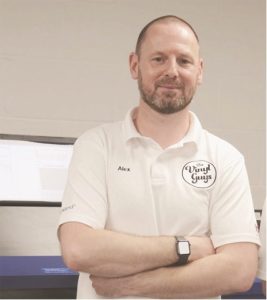
Alex Liggett
‘Interesting things to come for the industry’
Alex Liggett, owner, The Vinyl Guys
I think anyone who runs print & cut wide-format machines would love some sort of feature that would print, cut, weed and add the app tape too, but I’ll try to think of some features that are more realistic.
I do think that there is scope for integrating some AI style intelligence into the machines to make the process of cutting after print and lam more seamless. A feature on roll-to-roll wide-format machines where you could feed any print into your machine (without crop marks) and a camera reads the job and intelligently places cut lines on it for you and you can edit them as you need.
On the newer machines that have touch screen controls, there is already visual instructions to help users with maintenance and cleaning, these systems could be further developed to work as a diagnostic feature where suggestions are made for resolving issues and lists of parts and part numbers are available to either save engineer time or speed up the process and ensure they come with the correct parts.
Greater remote control of your machine and the ability to change over materials without being in the print room in person. We can already operate and monitor wide-format machines remotely but on the condition that we already have material loaded in and the machine is ready to go. Having the ability to have a selection of materials ready to go, which would self-load would make for a truly remote print process.
I do think that where we are currently with wide-format print, in terms of productivity and quality is brilliant. The versatility of modern-day machines allows print businesses to offer a huge range of diverse products from one machine and I think that as long as the rate of material development continues alongside machine development there will be some interesting things to come for the industry.

Richard McCombe, Graphic Warehouse
‘Speed, versatility, and scalability’
Richard McCombe, marketing manager, Graphic Warehouse
Wide-format printers are a huge investment, and for us at Graphic Warehouse, it is important that they can meet our needs now and well into the future. Our fast-moving, dynamic workflow is constantly evolving, and our printers need to cope with that and support us long-term.
Speed and reliability are our key considerations. We will always want our printers to drive our production, pushing the boundaries of print speed without sacrificing quality. We expect printhead technology to continue improving and delivering this additional speed.
Our most recent investment was in a Liyu Platinum Q3-XL Pro UV hybrid printer. Reliability is crucial to us. Since we got it, we’ve only had to call Liyu twice – once was just a courtesy check-in. Wide-format printers must be built with robust components and intuitive maintenance features to ensure minimal downtime.
Versatility is also key and drove our decision to purchase the Liyu. The print heads can be easily upgraded, meaning we weren’t just buying for today but for the future. Modular designs that allow for easy upgrades and customisation are key considerations. This includes the ability to adapt to new ink technologies, media types, and print applications.
Finally, sustainability needs to be seriously considered. To reduce waste, printers should incorporate the latest innovations in energy efficiency and consumables management.
To sum up, the wide-format printers of tomorrow should deliver the speed, versatility, and scalability to work alongside us and help us meet our business’s ever-evolving challenges.
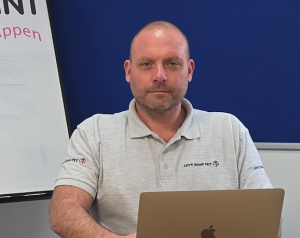
Jonathan Hopewell Love Your Print
‘Hybrid is the key’
Jonathan Hopewell, managing director of LoveYourPrint.com
For us, wide-format printers must be versatile, reliable, and able to meet the demands of sustained business growth. We recently purchased a hybrid printer from China Print Supplies because the owner, Scott Clutton, demonstrated that it can seamlessly handle diverse printing needs and expand service offerings.
The SinoColor from CPS is a hybrid large-format printer that opens up many new markets and combines the best of roll-to-roll and flatbed printing. While you may want all kinds of features and functionality for the future, you also have to be flexible enough to go where the business and the market take you. That’s what I was really looking for in a new printer: the power to adapt.
Versatility is paramount because it allows us to target a broad range of clients. I target trade customers and photographers with interior decor, including wallpaper, murals, splashbacks, tiles, and more. UV is a great ink that can print just as well roll-to-roll and flatbed, delivering an incredible range of applications. This is what I am looking for: a printer that can do what I need now and adapt to meet my business needs as I expand and diversify.
Hybrid is the key for me. Either flatbed or roll-to-roll would have had limitations. I can now do a good all-round job of everything rather than specialise in one thing and miss out on everything else.
The printers need to be fast, reliable, and good value, but the people you purchase from are just as important. Trust is critical. Scott was a great help. He highlighted how the printer would do what I needed now and the limitations that other printers might impose. He also showed me how this printer could potentially take me in different directions as my business developed.
We got on really well, and I trust him to do the best by me and that is just as important as anything else when looking at investments like this.

Nathan Swinson Bullough, Imageco
‘The future of print is very bright’
Nathan Swinson-Bullough, managing director, Imageco Visual Imaging
The future of print is very bright, but I think there is still room for improvement in the printers of tomorrow. I would like to see more improvements in sustainability, everything from the ink technology to the machine themselves, inks need to be fully sustainable, recyclable, on the materials which they are applied and water-based. There has been development in this by the likes of HP and I would expect to see even more rapid development over the next five to 10 years. Machines should be made from recycled materials and fully recyclable end of life, the way they are designed and built should allow for the simple removal and replacement of parts by operators and the parts made from recycled material and have the ability to be recycled.
From a production point of view quality and speed will continue to get better, but I would like to see more in the way of machine learning. Maintenance reporting to prevent breakdown, automatic error detection and communication between print files and the machine. AI will automate this even further which will help reduce waste and down time, I would like to see AI used in this way and improve efficiencies so that breakdowns don’t happen, material isn’t wasted, energy is reserved and the operators focus more and the production of the machines. AI will be seen more over the coming years and will play a part in how machines run and also communicate to accounting/ production scheduling/ ink and material ordering so that processes become more efficient and profitable.
I’d like to see more in the creative possibilities, development in what we can print on to, and how that process looks to give amazing creative effects. Maybe one day even motion can be printed but that is being very futuristic.