
A huge number of PSPs offer vehicle wrapping as a service, but not many know about architectural wrapping and the market it brings. In this issue’s diversification feature, assistant editor Ana Lambert explores the sector of architectural wrapping and how it can not only create customer retention but also new opportunities.

William Smith Architextural training
Sustainability in the industry has been a hot topic. Making sure the industry is less wasteful and more conscious of its eco-impact and a way to tackle that is to repurpose and refurbish.
So, if you have a client that’s wanting to spruce up a kitchen, boardroom or office, architectural wrapping is a great way to refresh a workspace or room without wasting sturdy materials that have stood the test of time.
The growing number of print providers and graphics companies taking part in the architectural wrapping movement can offer customers services they may need alongside their existing services.
Materials that you know
Entering a new sector can be daunting, but many manufacturers of vinyls and films have also branched into architectural wrapping alongside their traditional offerings.
The principle of architectural wrapping is straightforward: Retain what works and change what the customer sees and touches.
Consider a hotel bedroom; its furniture and fittings may remain structurally sound long after their appearance has become dated; replacing them not only means an added cost and disruption, but also waste.
The same approach has relevance across shops, offices, hospitality venues and homes. Walls, partitions, doors and fitted furniture all offer possibilities, provided the surfaces are suitable.
For instance, William Smith launched its Architextural interiors division in 2017, and opened a dedicated facility in the same year.
It stocks 3M DI-NOC, Cover Styl and LX Hausys within its architectural division, highlighting the well-known names already within the industry for graphics and vehicle wrapping.
Metamark also delved into the interior wrapping business, with its MiA interior architectural films.
MiA is a range of self-adhesive films designed to transform existing interior surfaces. Instead of removing and replacing serviceable fittings, installers can give them a new finish.
Applying MiA offers an alternative, refreshing suitable surfaces while reducing the work associated with replacement, and for hotel operators the potential benefits are lower costs and less disruption to business.
Alongside William Smith and Metamark, Spandex, a well-known brand for vehicle and graphics films and vinyl, also stock architectural films.
It stocks family names such as, Arlon, 3M, ImagePerfect, Cover Styl, Avery Dennison and Orafol.
After that helping hand
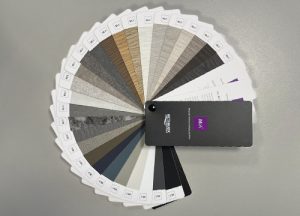
MiA Swatch
It can be quite daunting to dip your toes into a new venture, especially when it could be vastly different from what you offer already, but within an industry that is forever evolving, training courses are a helping hand to those wanting to diversify into a new endeavour.
There are many courses available to those looking to expand their services; a few come from well-known names within the industry, such as William Smith, Spandex and the CVI Group.
Spandex offers an Architectural Refresh Course, which is an introduction to surface wrapping for interior and commercial spaces. It also offers a 3M DI-NOC preparation course which is a course that can help a business achieve the 3M Endorsed Status.
Also, from Spandex are the architectural detailing course and an interior and décor wrap course, which will be coming soon.
Alongside those, William Smith has its Training Academy, which runs two-day courses in basic Architextural application, kitchen wrapping, interior film for commercial projects and 3M DI-NOC application.
An optional one-day assessment completes the route to 3M Endorsed DI-NOC Installer status. A one-day Avery Dennison Facade Film course and an Online Training Academy, launched in 2023, complete the programme.
The newest addition is the free Architextural Crash Course, a 10 minute online introduction for sign makers and wrappers considering the sector.
John Raine, training and applications manager at William Smith Group 1832, said: “There’s a lot of curiosity out there about architectural wrapping, but not always a clear way in.
“People assume it means retraining from scratch, when actually a good chunk of what they already do as wrappers applies directly.”
Wrapping existing fixtures lets clients update interiors with less cost, downtime and waste than a full replacement. The films carry the fire certification that commercial specifiers require. William Smith stocks brands that installers and specifiers can trust. 3M DI-NOC, Cover Styl and LX Hausys give customers the certification, testing and pattern choice to stand behind every job.
John added: “Sign and graphics businesses are always looking for the next sensible diversification, and architectural wrapping keeps coming up as one of the better options.”
Also providing architectural wrapping training is the CVI Group, run by professional wrapper Chris Edwards. The courses focus on how to install, the challenges you may face and how to overcome them with different techniques and an understanding of the materials.
The courses that Chris and his team provide are the LX Architectural Training, which are on behalf of SPACE Architectural, and a certificate is issued on completion as recognition for being an approved SPACE Architectural Interiors Finishes installer for LX Hausys Interior film.
Benefit of diversification
But regardless of the materials and the training available, diversification at its core isn’t the act of abandoning what you already know; it’s knowing how to expand on that existing knowledge to provide customers and potential customers with a more comprehensive service.
It’s most certainly not for everyone, and while most PSPs do offer more than one service, architectural wrapping can be a great tool for businesses focused on one sector, for instance, graphics or printed vinyls or wall coverings.
Those looking to expand their services can take part in either the training courses or reach out to associations to find out more about how to either diversify or gain new skills for not only customer retention but to gain new customers too.