
In this article, Stuart Mason, founder of Here’s How To, explains why the smartest print businesses are becoming CHOICE businesses, and why every business owner should be building one.

Make the business work for you
For years, the term lifestyle business has been treated almost as an insult, suggesting something small, lacking ambition, and run by someone who would rather spend Friday afternoon on the golf course than build a proper business.
Apparently, unless you’re employing dozens of people, investing hundreds of thousands of pounds in machinery, working ridiculous hours and worrying about how you’re going to pay the wages every month, you’re not running a serious business.
What a load of rubbish.
I’ve spent much of my working life in the print industry, including building what became the largest chain of independent print centres in the country, and I’ve seen enough of the good, the bad and the downright ugly to know that the size of a business tells you remarkably little about its success.
I’ve also experienced what happens when a business becomes so demanding, complicated and expensive to operate that the person who owns it ends up working harder than almost everyone else, carrying all the financial risk and wondering where the freedom they originally went into business to achieve has disappeared.
Which brings me to something I’ve become increasingly passionate about, and the subject of my next book.
The CHOICE business
My argument is simple, every business should be a “choice business”, or a lifestyle business, because the lifestyle it delivers should be determined by the person who owns it, rather than dictated by the demands of the business itself.
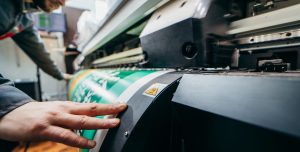 If your ambition is to build a £10 million print empire employing 100 people, fantastic, but if you’d rather build a £1 million business employing nobody, generating an excellent income and giving you the freedom to spend six weeks travelling every year, that’s equally fantastic.
Neither ambition is right or wrong, because the whole point of owning a business should be having the freedom to make those choices, yet few of us do.
And here’s where things become particularly interesting for our industry.
The rules have changed, but have you?
For decades, the traditional route to building a successful print business involved investing in equipment, employing operators, finding premises, recruiting salespeople and gradually increasing capacity as turnover grew.
The problem was that every increase in capacity usually brought another increase in overheads, and before long the business needed more work simply to feed the machine it had become.
Buy another press, and suddenly you need another operator, more space, additional finishing equipment and enough work to justify the investment, regardless of whether that work is particularly profitable.
I’ve seen businesses chasing turnover with such determination that they’ve completely forgotten the original purpose of being in business, which presumably wasn’t to spend their lives worrying about finance agreements, machinery breakdowns and whether the next big order would arrive in time to cover the wages.
 But the world has changed, and the opportunities available to today’s print entrepreneur are almost unrecognisable compared with those available just a few years ago.
Technology, artificial intelligence and outsourcing have fundamentally changed what a print business needs to own, employ and operate.
The question is whether business owners are prepared to change with it.
Artificial intelligence isn’t coming; it’s already here
There seems to be a perception that AI is something businesses should be investigating for the future, when the reality is that it’s already capable of transforming how even the smallest print business operates today.
Consider how much time is consumed by administration, preparing quotations, following up enquiries, managing customer communications, producing marketing material, organising workflows and dealing with the countless repetitive tasks that fill an average working week.
Many of these activities can now be automated, accelerated or supported by technology that costs a fraction of what traditional staffing and administrative arrangements would require.
A modern CRM system can manage customer relationships, record conversations, schedule follow-ups, identify sales opportunities, automate reminders and ensure that potential business doesn’t disappear simply because somebody forgot to make a telephone call.
 Combine that with AI tools capable of helping prepare proposals, draft communications, analyse information and support customer enquiries, and suddenly a business owner has access to capabilities that previously required several members of staff.
Of course, AI isn’t perfect, and neither is automation, but the point isn’t to eliminate human judgement or replace every conversation with a chatbot.
The point is to stop wasting valuable human time doing things that technology can handle more efficiently.
For a relatively modest monthly investment, a small print business can now operate with levels of organisation, responsiveness and commercial intelligence that would once have been associated with a much larger company.
And when you start combining these tools, the possibilities become even more interesting.
Who says a print business needs printing equipment?
Here’s a question that might upset a few people.
Why does a print business actually need to own a printing press?
Before anyone starts throwing things at me, I’m not suggesting that manufacturing businesses are finished, or that investing in equipment is automatically a mistake.
There are excellent print manufacturers operating highly profitable businesses, with carefully selected equipment, strong utilisation and genuine competitive advantages.
But there’s a massive difference between investing in machinery because it delivers a measurable commercial advantage and buying machinery because that’s what print businesses have traditionally done.
Today, a print entrepreneur can outsource virtually everything. Print Management is no longer about the big in-house accounts.
Business cards, brochures, catalogues, leaflets, books, labels, packaging, display graphics, signage, vehicle graphics, exhibition stands, promotional products and practically anything else a customer might reasonably associate with print.
The manufacturing expertise, technology, capacity and investment already exist within an extraordinary network of specialist suppliers, many of whom are exceptionally good at what they do.
Why replicate all that investment when you can access it whenever you need it?
Instead of owning expensive equipment that needs feeding, maintaining and eventually replacing, you can concentrate on finding customers, understanding their requirements and delivering the finished product through carefully selected manufacturing partners.
And contrary to what some traditional printers might believe, outsourcing doesn’t automatically mean sacrificing margin.
Quite the opposite, in fact.
When businesses properly calculate the real cost of producing work in-house, including premises, equipment finance, depreciation, labour, maintenance, utilities, administration, waste and all the other overheads that mysteriously disappear from some costing calculations, outsourcing can produce a better commercial result.
That doesn’t mean outsourcing always wins, because every job needs to be assessed on its genuine costs, quality requirements, lead times and risks.
But it does mean the decision should be based on commercial reality rather than emotional attachment to machinery.
Turnover is vanity, profit is sanity, and cash is what keeps the lights on.
A million pounds of turnover achieved with substantial overheads, constant investment and endless operational headaches isn’t automatically better than a million pounds achieved through a lean, efficient operation with excellent margins.
And remember, profit isn’t cash, something far too many business owners discover when the bank balance refuses to reflect the impressive figures appearing in their accounts.
The biggest opportunity isn’t technology; it’s customer service
 Here’s where I believe the real opportunity exists, and it’s something our industry has been spectacularly poor at recognising.
Six-star customer service
Not five stars, because five stars has become the expected standard, and certainly not the sort of customer service where somebody answers the telephone, takes an order and considers that a job well done.
I’m talking about building a business where the customer experience is so good that customers stop comparing you with every other printer offering a lower price.
Think about the typical customer buying print.
Do they really care whether you own the press, lease the press or have their work produced by a specialist manufacturer 200 miles away?
In most cases, absolutely not.
They care whether you understand what they’re trying to achieve, whether you make the process straightforward, whether you offer sensible advice, whether you deliver what you promised and whether dealing with you is a pleasure rather than a bloody nightmare.
Yet our industry continues to obsess over equipment specifications, production speeds and price comparisons, while overlooking the enormous commercial value of simply being brilliant to deal with.
 Imagine a print business where every enquiry receives a prompt, thoughtful response, every quotation is followed up, every customer feels valued and every problem is handled before it becomes a complaint.
Imagine remembering when a customer last ordered, anticipating when they’ll need more, suggesting improvements to their marketing materials and becoming the person they telephone before they’ve even considered asking anyone else.
That’s where technology becomes genuinely powerful, because AI, CRM systems and automation can take care of much of the administration, leaving the business owner free to concentrate on relationships, creativity, problem-solving and delivering an exceptional customer experience.
And those are the things customers are often prepared to pay more for.
Stop competing on price and start competing on how valuable you are to your customers.
A million-pound business with no employees?
A few years ago, the idea of someone operating a million-pound print business without employing a single person would have sounded ridiculous to many people in our industry.
Today, entrepreneurs are demonstrating that substantial profitable turnover can be generated through lean, outsourced business models, supported by technology, specialist suppliers and carefully managed customer relationships.
That doesn’t mean there are no people involved, because the work still needs producing, delivering, managing and supporting, but those people don’t necessarily need to appear on your payroll.
Nor does it mean such a business runs itself, because supplier management, cash flow, quality control and customer relationships still require considerable attention.
But it does demonstrate that the traditional relationship between turnover, employee numbers, premises and equipment is changing.
And that’s enormously exciting.
It also challenges another misconception about lifestyle businesses, namely that they’re somehow less valuable than conventional businesses.
A well-managed, profitable business with loyal customers, reliable suppliers, documented systems and limited owner dependency can absolutely have value, regardless of whether it owns a factory full of machinery.
The important distinction is whether the business can operate successfully without its owner being personally responsible for everything, because a business that depends entirely on one individual is always going to present challenges when that individual eventually wants to step away.
That’s why building a CHOICE business isn’t simply about enjoying a better lifestyle today, it’s also about creating something that offers genuine options tomorrow.
You might want to grow it, keep it, hand it over, bring in management or eventually sell it, but those choices become considerably more attractive when you’ve built a business that isn’t completely dependent on you.
Fortune favours the bold
I’ve never believed that success should be measured by the number of people you employ, the size of your premises or how impressive your equipment looks when someone visits.
Success should be measured by what your business actually delivers, financially, professionally and personally.
For some owners, that means building a substantial manufacturing operation, while for others it means creating a highly profitable, technology-enabled business with minimal overheads and the freedom to work from wherever they choose.
Both can be successful lifestyle businesses, provided the lifestyle is a deliberate choice rather than an accidental consequence.
The print and display industry has never lacked opportunity, but too often we’ve been guilty of looking backwards, defending traditional ways of working and assuming that the future must resemble the past.
It doesn’t.
We have access to extraordinary manufacturing capabilities without necessarily owning them, sophisticated technology without employing an IT department, and powerful customer management systems without the overheads that once accompanied them.
What we need now is the imagination, confidence and commercial discipline to take advantage of those opportunities.
So perhaps it’s time to stop asking how big your print business could become and start asking what you actually want your business to do for you.
Because building a business that delivers more profit, more freedom and more life isn’t a lack of ambition. It’s ambition with a purpose.
And in an industry that constantly describes itself as vibrant and dynamic, perhaps the greatest opportunity belongs to those prepared to prove it.
Fortune favours the bold, and our industry has never offered more opportunities to be bold.
You just need to be vibrant and dynamic with it.


