
The BPIF’s Printing Outlook survey is sponsored by Canon
With the political uncertainties and conflicts in the Middle East, the UK printing industry has seen a downturn in Q2 this year according the BPIF’s latest Printing Outlook survey.
The survey found that in Q2 over two-fifths (42%) of printers experienced a decrease in their output levels, the negative outcome is the most negative output balance reported since Covid.
Kyle Jardine, BPIF economist, said: “Companies have referenced confidence being hit by uncertainty, leading to delays in purchasing decisions and investments. Most costs have increased by similar amounts in a short period of time – but not all have been passed on as price increases.
“Despite the future direction of Government policy still being unclear, and the lack of endgame certainty over conflicts in the Middle East and Ukraine – the industry is forecasting that Q2 will be the low point for 2026 and that confidence and activity levels will improve in Q3.”
It also found concerns over the level of sales in the industry have increased to lead a reorder to the list of printers’ top business concerns. Sales levels sits ahead of profit levels, and the belief that competitors are pricing below cost.
The survey found that an increased proportion of companies reported factors restricting capacity in Q2, the shortage of suitable skilled employees was the most significant constraints.
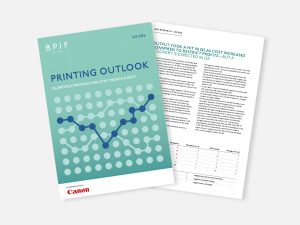
The Printing Outlook from the BPIF, showed negative results for Q2 but optimism for Q3
In July, labour costs remained the largest cost component with a growing 34% share of total costs, with just under half (49%) of printing companies holding steady margins in Q2 but the pressure remains strongly negative.
Duncan Smith, country director, Production at Canon UK & Ireland, said: “The print industry has always demonstrated a remarkable ability to adapt. Whether that’s responding to changing customer expectations, embracing new technologies or navigating economic uncertainty, businesses across our sector continue to show resilience, innovation and determination.
“As we move through 2026, organisations are balancing a wide range of priorities, from improving operational efficiency and investing in future growth, to meeting evolving sustainability commitments.
“The insight and guidance provided by BPIF continues to be an important resource for the industry, which helps businesses understand market trends, navigate challenges and make informed decisions with confidence.”