Delving into the world of wide-format printing, there are a few industry names that are making their mark on creating a more environmental way of working. Assistant editor, Ana Lambert, investigates how the industry is utilising recycling schemes to become greener.
With environmentally-friendly programmes starting to be made an integral part of the industry, it’s becoming more and more common to see businesses create new initiatives aligning with it’s sustainability goals.
Touched upon in last issue’s environment feature, AI is a grey zone for the environment but by creating schemes that offset these grey areas, then actions can be made to make print more eco-friendly.
Among the businesses creating industry-leading sustainability plans, a few stand out, including Corplex’s innovative closed-loop recycling system
and Tradeprint and Antalis’ partnership for a banner recycling scheme.
A ‘world-first’ recycling system
 Taking initiative of creating an innovative way to recycling, Corplex partnered with Global Media and The Delta Group to create a creative closed-loop recycling system for OOH media.
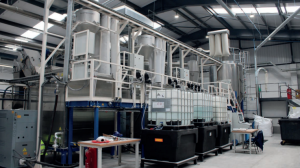
At the centre of the project is Corplex’s new multi-million-pound 22,000sq/ft de-inking facility at its Gloucester site, and is designed for outdoor signage mounted on the side of London busses, made from polypropylene Correx board.
The reason for this new system came about from how traditionally printed vinyl was glued onto the boards, which were reused two to three times.
Then when they came to end-of-life, the boards were incinerated or sent to landfill – creating non-recyclable waste and a higher carbon footprint.
Now, the new closed-loop system allows direct returns of the printed Correx boards, post advertising campaign, back to Corplex’s Gloucester site after each campaign.
There the boards are shredded, washed, and recycled into clean, high whiteness PP flakes. These are then re-extruded into new boards with up to 70% recycled content – an industry first.
Lucas van der Schalk, CEO of Corplex, said: “This is a world first for printed PP boards and moves the needle on closed-loop recycling. The level of investment we’ve made in our unique de-inking facility is fully justified when you look at the results. Partnering with Global and The Delta Group demonstrates how collaboration can make a sustainable difference.”
Corplex’s mechanical de-inking system is the engine behind the groundbreaking project; one that fully closes the loop while making significant CO2 savings. The process reduces carbon emissions by more than 500t annually, cutting the footprint by 80%.
This is the equivalent to 1,200 one-way flights from London to New York, or removing 110 cars from the road each year.
Lucas added: “The shift toward reusable, recyclable substrates is no longer about feasibility – it’s about adoption. When combined with high-efficiency de-inking, polypropylene offers the clearest path to circularity in printed signage.
“Stakeholders must now evaluate signage not just on print quality and durability, but also on total lifestyle impact and recyclability infrastructure.”
Leading on from this creative de-inking recycling system, is another type of recycling scheme that focuses on banners.
The banner return pilot scheme
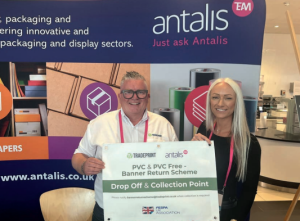
This UK-first scheme highlights the importance of recycling the banners, a sheet material that is used in both print and signage within the UK.
Tradeprint, working closely with Antalis – along with Reconomy, FESPA UK and the IPIA – have created the Banner Return Pilot Scheme, which launched January 5, 2026.
The scheme is designed to significantly reduce the environmental impact of PVC and PVC-free display banners. Built on circular economy principles, the scheme enables customers to return used banners for responsible recycling.
Collected materials are repurposed into durable infrastructure products, such as traffic cones and road barriers, providing a smarter end-of-life route than landfill or incineration. The aims of the scheme are to: reduce environmental impact from PVC and PVC-free materials, educate and encourage customers to adopts sustainable behaviours, increases customer loyalty, establish a scalable return model in print, and inspire printers to develop similar return schemes.
Anthony Rowell, sales and customer success director and sustainability lead for Tradeprint, said: “In a circular world, waste isn’t the end; it’s the beginning. Recycling isn’t just about recovery; it’s about respect for resources, for the planet, and for future generations.
“We are all really excited about this trial and so grateful for the support from the team at Antalis, Reconomy, FESPA UK and the IPIA. I genuinely hope this inspires others to develop similar schemes.”
As part of the pilot, Tradeprint is working closely with Antalis, to leverage its UK depot network as regional drop-off points. Tradeprint’s collaboration with Katie Farr, marketing and communications manager at Antalis, reflects its shared commitment to driving sustainability across the print supply chain.
The initiative has also benefited from strong early backing by Jon Hutton of FESPA UK and Reconomy, both of whom have supported Tradeprint during the development of this pioneering approach.
Rowell added: “As we transition away from problematic plastics like PVC, it’s crucial we support our customers in making better, informed choices.
This pilot helps us do just that while strengthening the commercial case for sustainability.”
The pilot includes customer education, return incentives, and data on the CO2(e) savings. Long-term, the ambition is to roll out a fully scalable model across the UK print industry. Tradeprint also said that they hope this scheme helps its partners, customers, and peers to create their own initiatives and schemes to make a more circular and responsible future for print.
This type of scalable scheme is a great way for the industry to look at what it can achieve when utilising not only partnerships but also likeminded businesses.
Looking to the future
These schemes are helping to provide a change in how the print industry’s sustainability consciousness is being shaped, creating not only awareness but understanding of how to frame them going forward.
These initiatives also show what businesses must either aim towards or be included in when creating or launching their eco-friendly schemes.